
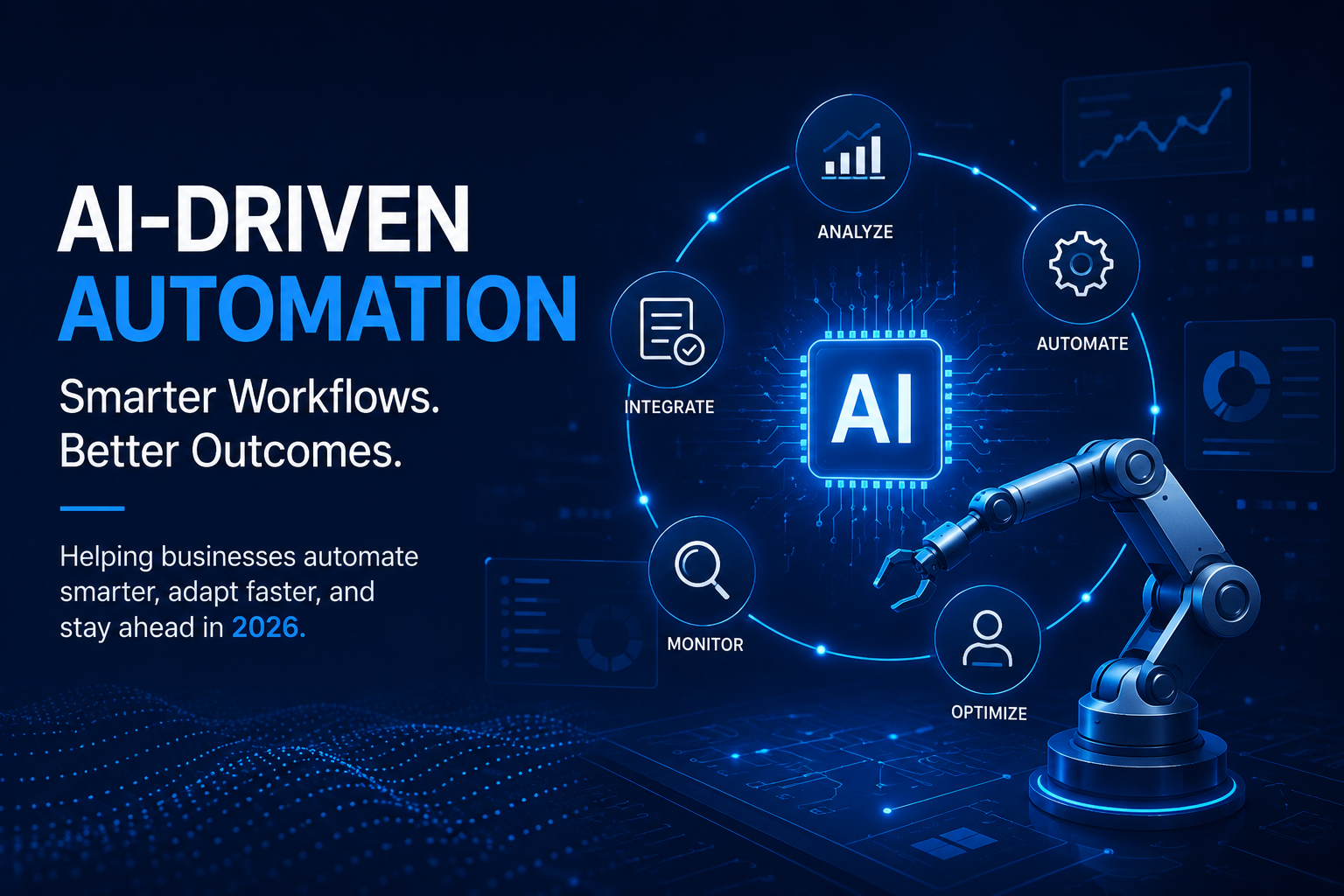
🚀 Why Businesses Are Moving Toward AI-Driven Automation in 2026
Introduction
Automation has been around for years, but the way businesses are using it is changing quickly.
Instead of automating only repetitive tasks, companies are now combining automation with AI to make systems more responsive, flexible, and useful in day-to-day operations.
This shift is helping businesses reduce manual work while improving visibility and decision-making.
---
What Is Actually Changing?
Traditional automation follows fixed rules.
AI-driven automation adds another layer by allowing systems to:
- Analyze incoming information
- Adjust based on changing conditions
- Identify patterns and issues
- Recommend or trigger next steps
The result is a process that is more adaptive instead of strictly rule-based.
---
Where This Shows Up in Real Work
1. Smarter Operational Workflows
Many teams still rely on manual steps between systems.
AI-driven automation can:
- Move information between platforms
- Trigger actions automatically
- Reduce delays caused by manual handling
This improves overall operational flow.
---
2. Faster Decision Support
Managers and operations teams often spend time gathering information before making decisions.
AI can help by:
- Summarizing large amounts of data
- Highlighting unusual activity
- Providing real-time operational visibility
This allows teams to react faster.
---
3. Customer and Internal Support
Businesses are increasingly using AI-powered systems to assist with:
- Customer inquiries
- Internal support requests
- Status updates and notifications
This helps reduce response times while keeping teams focused on more complex tasks.
---
4. Monitoring and Issue Detection
One growing trend is using AI to monitor systems continuously.
This can help:
- Detect failures earlier
- Identify process bottlenecks
- Reduce downtime
Instead of waiting for problems to be reported manually, businesses can respond proactively.
---
What This Means in Practice
Companies applying AI-driven automation effectively are seeing:
- Less repetitive manual work
- Faster operational response times
- Better process visibility
- Improved consistency across teams
Most importantly, many of these improvements can be made without replacing existing systems.
---
How SPD IT Solutions Approaches This
At SPD IT Solutions, the focus is on practical automation that supports real business operations.
This includes:
- Improving existing workflows
- Reducing operational friction
- Connecting systems more effectively
- Delivering measurable operational improvements
The goal is not to add unnecessary complexity, but to make systems work smarter together.
---
Final Thoughts
AI-driven automation is becoming less about replacing people and more about helping teams operate more efficiently.
Businesses that focus on practical improvements instead of chasing trends are seeing the best long-term results.
---
📩 Get Started
If you are exploring ways to improve efficiency through AI and automation, now is a good time to evaluate where small improvements can create meaningful operational impact.
👉 Reach out to SPD IT Solutions to start the conversation.